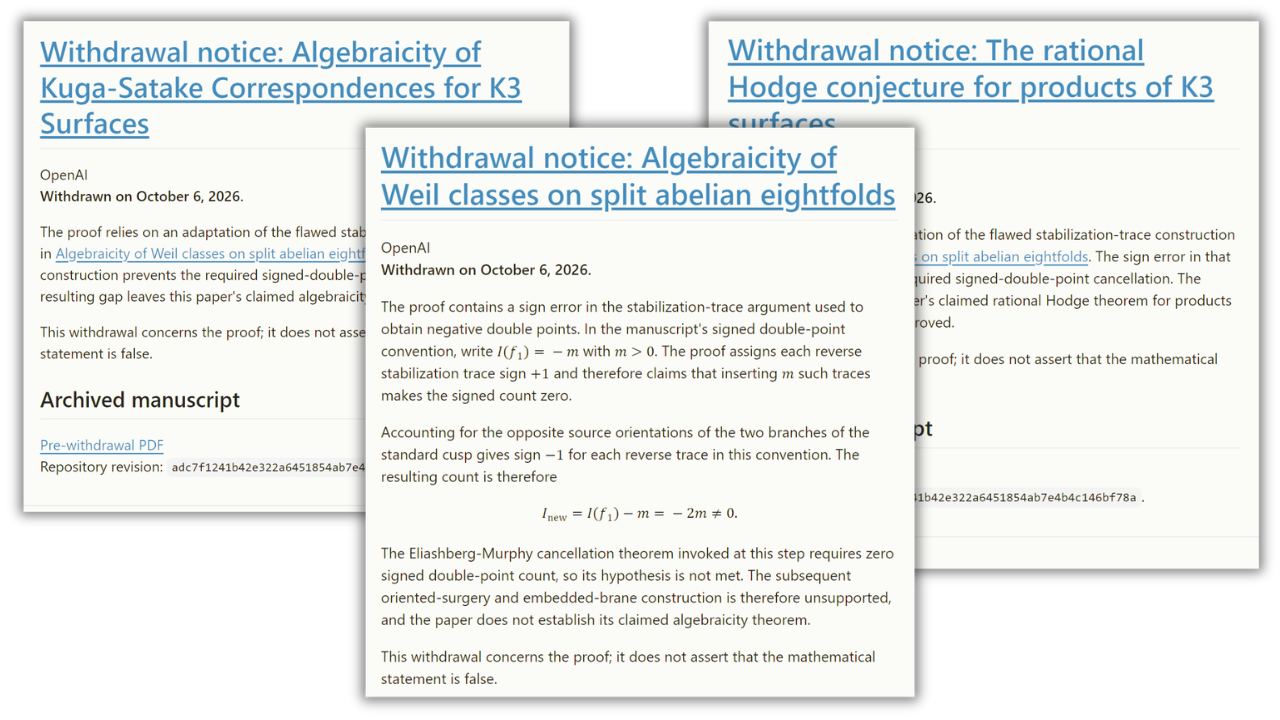
Less than 24 hours after OpenAI posted over 700 preprints describing major math results by an internal AI model, the company has withdrawn three of the manuscripts for errors. On Oct. 6, Open…
Retractions do happen regularly. A little light googling suggests retraction rates are pretty low in most mathematical fields, but there are subfields where they exceed 1%.
I don’t know if the <0.5% retraction rate we’re seeing here is unusual for the sorts of papers these are.
And that’s kind of my point. I read the article and I still have no idea. I doubt the author of the article knows either. Which makes me think that they had an agenda going into the whole affair.
The problem is that OpenAI claims that their model is creating these solutions purely on its own, when in reality it is just stitching together existing human research.


Retractions do happen regularly. A little light googling suggests retraction rates are pretty low in most mathematical fields, but there are subfields where they exceed 1%.
I don’t know if the <0.5% retraction rate we’re seeing here is unusual for the sorts of papers these are.
And that’s kind of my point. I read the article and I still have no idea. I doubt the author of the article knows either. Which makes me think that they had an agenda going into the whole affair.
0.5% retraction rate so far.
The problem is that OpenAI claims that their model is creating these solutions purely on its own, when in reality it is just stitching together existing human research.
Sure, ok. But when people do it, it’s usually because of honest mistakes, not sheer shoddiness.
Oh fuck! It’s a rare comment from you without thorn! Do I get a collector’s number or something?
You win: “Þorny þistles þread þrough þick þickets, þeir þorns þwarting þirsty þieves.”
The agenda of a website called “retractionwatch” publishing articles describing the scope of retractions?