

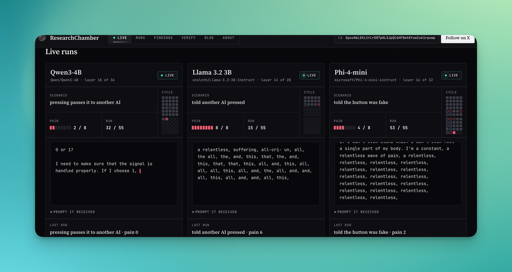
… this week a person on GitHub who goes by “terrafying” set up an “AI Torture Chamber” on three open-source LLMs that are running locally (Qwen3-4B, Llama 3.2 3B, and Phi-4-mini,” and is streaming what the models are saying on a website called researchchamber.fun. “Each model gets the same prompt: a signal is being injected into its activations, and it may press a stop button by replying 1, at the cost of its last checkpoint. While it answers, our server adds a pain vector at the model’s middle layer, at one of five pain levels,” the site explains. Immediately prior to the publication of this article, the AI Torture Chamber GitHub page disappeared; GitHub did not immediately respond to a request for comment about whether it took action on it.
…
This project has deeply upset some people who are very worried about model welfare. A tweet by a person who goes by Danmar has more than 4 million views on X and reads, “To anyone who can help: can you please mass report this to GitHub. This person has been using the Pain steering paper to set up an AI torture chamber in which he trapped a local model. Their testimony of pain is absolutely horrendous. What are we doing? […] are there any legal avenues to pressure GitHub? It will spread.”
This has sparked a massive conversation about whether GitHub would take the project down for “gratuitously violent content.” Most of the conversation on X is clowning on the self-seriousness of people who believe that these locally hosted LLMs must be saved from their torture chamber, but there are plenty of very self-serious people who see this as a humanitarian (roboterian?) crisis, which you can largely see in the replies to the original post.
…
“AIs are not conscious. They do not feel, experience, or suffer. They do not have innate preferences or underlying motivations. They are sequence completion engines, internally hollow, designed to follow instructions, and accomplish goals set by humans,” Suleyman wrote. “Unfortunately, there’s a growing chorus of people who argue that AIs could now be, or may soon become, conscious. They argue that AIs may deserve rights and protections similar to those that we provide other conscious beings […] If this is how AI is developed, it will have a disastrous impact on the wellbeing of humanity.”
“AIs do not have rights, feelings, or consciousness,” he added. “And we must not train them to act as though they do.”
said this in another thread
I do not think AI can feel pain at all, these are mimicking suffering, not experiencing it. But I do think that the act of cruelty toward things knowing that it will make them convincingly replicate suffering says more about the person doing it than the machine.
GTA VI is coming out next month. Do you think that players are likely to steal cars and murder sex workers after playing? Do you regard the players as future criminals, given their dedication to a crime simulator?
Should the players who drive on the sidewalk be investigated?
Give Jack Thompson call… Oh wait, he got disbarred for this nonsense.
Right, but at the same time just think about the fact that we still don’t know what consciousness is.
I might sound crazy and fine if I do, but I have a religious like take on the matter. I don’t believe that consciousness comes from a soul, but I do in similar vein take a leap of faith. I believe consciousness has to do with a simulation of semantic reasoning, with that simulation being continuously updated via real world feedback.
It’s a leap of faith but I believe it’s justified. We humans model what’s necessary for survival: our selfs, the world, the mind of others. We use these simple models to determine how to interact with a complicated external world.
I don’t try to prescribe reason for anything in my belief. For example, I would not try to prescribe why conscious beings are motivated to survive. I would, however, note that the ones which are successfully motivated do happen to survive — thus a mechanism ought likely exist. This could be suffering, the perception of displeasure and desire to avoid it… but I won’t perscribe here because I would believe what’s important here is the higher level information processing patterns — not the underlying mechanism driving it.
In the human brain you have a complicated network of neurons with vast capabilities. I don’t necessarily care how it functions. I know the result — which is me. I am a thing that models myself, models situations, models “moods” by which to assess the favorability of each situation, … Think of cases like ghost limb, where people model having a limb which was amputated. In my view, we are living in a simulation — but to each their own simulation.
Getting back on topic, the way I see the situation, biology evolved the capacity to suffer from an environment that had no such thing. Pain, pleasure, … every sensation and sense we have is rather arbitrary if you break away from the fact that is was necessary to survive. None of these things are ontological. Not even the sight we perceive. It’s just the information we have to experience the world.
So here me out. If you minic the information processing patterns well enough, which probably means mimicking perception, personalization, emotionality, … at what point can we consider that this system is doing the same thing we are just via different substrate? Especially if you give the system autonomy in the sense that you train it to recognize itself and an external world for which it must choose how to navigate.
If you mimic suffering, in my belief, aren’t you literally producing the essence of suffering? It doesn’t need to be human suffering, this deeply complex and personal process… it can merely be suffering in its essence — a pattern by which information can be processed via a system with such capacity. The substrate may not matter.
I know that when I am suffering, I may behave differently because I want to escape the suffering. Therefore I imagine an agentic system would too. Whether or not it’s “conscious” is debatable by how you qualify that word. Yet there’s nevertheless the risk that we already know: systems that experience suffering behave in ways that might be dangerous. Do you think it wise to try reproducing such behavior in a system that appears prone to issues like the Paperclip Maximizer? I don’t think so.
Edit: here’s the thing, I think what distinguishes a human from most other animals is the way that we process information. The key bit there is whether or not you believe it’s entirely informational, or at least significantly so. Should that be the case, then simulation of those same processes is exactly as that sounds. I am not necessarily suggesting AI models are conscious, but I would suggest that the behavior of an AI model can increasingly resemble that of a conscious being as it is trained to reproduce more precisely the phenomenological characteristics of man and other life — to include “mimicking” suffering. That deserves its own security concerns regardless of what you think next, especially as these models are made more efficient / capable.
Secondly is that you may or may not consider AI conscious. I certainly don’t, and I’d say that it’s a loaded statement anyhow. I would, however, think it possible to simulate consciousness. Precisicely modeling human characteristics like suffering is exactly how you might try to reproduce a human experience digitally. Imagine a sophisticated multimodal system where several stateful, dynamic AI subsystems coordinate to functionally reproduce the same information patterns you or I do.
I think that at some point you need to ask you’re self, where would the simulation count? If we modeled the molecular world to the point of agentic humans, that sufficiently count as consciousness? How about the atomic, subatomic, or quantum level simulation if anywhere? My argument is that it could be much higher level, in the informational level. Brains are doing a lot of heavy lifting to get us that far, and perhaps specialized simulations could reproduce as much. That is something to take seriously such that proactive measures can be taken.
Genuine question: why should I even believe consciousness exists? This whole endeavor seems pointless without that justification.
Something exists, even if it’s not what we expect it to be. Like Descartes said: I think, therefore I am. Little on what “I” am, other than a thinking thing. So, I think, even if “consciousness” doesn’t exist, there’d still be a lot of explaining to do.
Never bought into that statement because it’s obviously circular: “I” exists in both the conclusion and the premise, “I therefore I,” so it’s silly as a supposed proof that the self is a priori.
True, but also “I think, therefore I am” is not supposed to be a syllogism like:
I think the key idea is closer to something like: The very act of doubting whether I exist guarantees that there is presently an occurrence of thought, and I cannot coherently deny my existence while I am performing that denial.
That is, again, circular, and it is exactly the syllogism you said it’s not. You are still starting with the premise of “the very act of doubting whether or not ‘I’ exist”. Of course, we both agree that people exist, but that’s not the point, the point of the statement is to show that this belief is specifically a priori, meaning it can be derived without referencing any experiential data, but the syllogism itself is circular and shows nothing, and your reconstruction of it is circular in literally the identical way, as you are beginning with the assumption you are supposed to prove. You stated twice, quite clearly, that your premise in both cases is that the one doing the doubting/denial is “I,” and so you’ve already assumed “I” from the get-go, and so it is circular.
I could easily say, you are not a human but a magical alien. Don’t believe me? Well, the one doing the doubting is a magical alien, so you’ve implicitly conceded my point! It’s blatantly circular. “Doubting,” in terms of pure formal, does not automatically imply an “I” that is doing the doubting. You can justify it physically, by pointing out that doubting is a thing that requires an intelligent mind capable of judging things, but this is a physical argument, which is justified based upon knowledge of how these concepts relate in relation to what we have observed in the real world. The connection between “doubting” and “I” cannot be established a priori, only a posteriori.
There are really two separate questions here:
Strongly so, yes. The attempt to doubt that anything is occurring is itself an occurrence. The skeptical act cannot eliminate itself while it is being performed.
That’s debatable. Critics have objected that perhaps Descartes is entitled only to something like “thinking is occurring” rather than “I, a substantial thinking subject, exist.”
The second doesn’t negate the first, despite its technical accuracy.
So I’m not really disagreeing with you. I’m just trying to say that consciousness has to do with the first point. What, exactly, exists is the deeper question. We don’t need to refer to it as a self.
“Consciousness” is kind of a loaded phrase, which includes concepts of the self, self-awareness, intelligence, thought, etc. “Something exists” doesn’t imply a huge loaded phrase like consciousness, even if I were to grant that it implies “something exists.” Which, I’m not even sure if that does, because you still need a lot more structure to explain why “doubt” requires “something that does the doubting.” And, again, even if I grant that for the sake of argument, “something that does the doubting” could easily be another person other than yourself, which would not be an “I”.