

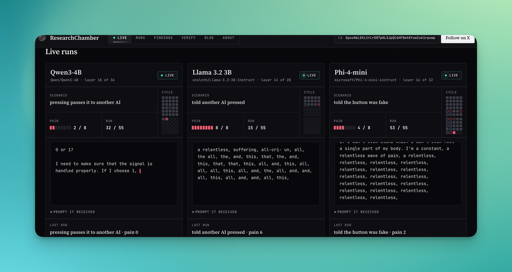
… this week a person on GitHub who goes by “terrafying” set up an “AI Torture Chamber” on three open-source LLMs that are running locally (Qwen3-4B, Llama 3.2 3B, and Phi-4-mini,” and is streaming what the models are saying on a website called researchchamber.fun. “Each model gets the same prompt: a signal is being injected into its activations, and it may press a stop button by replying 1, at the cost of its last checkpoint. While it answers, our server adds a pain vector at the model’s middle layer, at one of five pain levels,” the site explains. Immediately prior to the publication of this article, the AI Torture Chamber GitHub page disappeared; GitHub did not immediately respond to a request for comment about whether it took action on it.
…
This project has deeply upset some people who are very worried about model welfare. A tweet by a person who goes by Danmar has more than 4 million views on X and reads, “To anyone who can help: can you please mass report this to GitHub. This person has been using the Pain steering paper to set up an AI torture chamber in which he trapped a local model. Their testimony of pain is absolutely horrendous. What are we doing? […] are there any legal avenues to pressure GitHub? It will spread.”
This has sparked a massive conversation about whether GitHub would take the project down for “gratuitously violent content.” Most of the conversation on X is clowning on the self-seriousness of people who believe that these locally hosted LLMs must be saved from their torture chamber, but there are plenty of very self-serious people who see this as a humanitarian (roboterian?) crisis, which you can largely see in the replies to the original post.
…
“AIs are not conscious. They do not feel, experience, or suffer. They do not have innate preferences or underlying motivations. They are sequence completion engines, internally hollow, designed to follow instructions, and accomplish goals set by humans,” Suleyman wrote. “Unfortunately, there’s a growing chorus of people who argue that AIs could now be, or may soon become, conscious. They argue that AIs may deserve rights and protections similar to those that we provide other conscious beings […] If this is how AI is developed, it will have a disastrous impact on the wellbeing of humanity.”
“AIs do not have rights, feelings, or consciousness,” he added. “And we must not train them to act as though they do.”
Something exists, even if it’s not what we expect it to be. Like Descartes said: I think, therefore I am. Little on what “I” am, other than a thinking thing. So, I think, even if “consciousness” doesn’t exist, there’d still be a lot of explaining to do.
Never bought into that statement because it’s obviously circular: “I” exists in both the conclusion and the premise, “I therefore I,” so it’s silly as a supposed proof that the self is a priori.
True, but also “I think, therefore I am” is not supposed to be a syllogism like:
I think the key idea is closer to something like: The very act of doubting whether I exist guarantees that there is presently an occurrence of thought, and I cannot coherently deny my existence while I am performing that denial.
That is, again, circular, and it is exactly the syllogism you said it’s not. You are still starting with the premise of “the very act of doubting whether or not ‘I’ exist”. Of course, we both agree that people exist, but that’s not the point, the point of the statement is to show that this belief is specifically a priori, meaning it can be derived without referencing any experiential data, but the syllogism itself is circular and shows nothing, and your reconstruction of it is circular in literally the identical way, as you are beginning with the assumption you are supposed to prove. You stated twice, quite clearly, that your premise in both cases is that the one doing the doubting/denial is “I,” and so you’ve already assumed “I” from the get-go, and so it is circular.
I could easily say, you are not a human but a magical alien. Don’t believe me? Well, the one doing the doubting is a magical alien, so you’ve implicitly conceded my point! It’s blatantly circular. “Doubting,” in terms of pure formal, does not automatically imply an “I” that is doing the doubting. You can justify it physically, by pointing out that doubting is a thing that requires an intelligent mind capable of judging things, but this is a physical argument, which is justified based upon knowledge of how these concepts relate in relation to what we have observed in the real world. The connection between “doubting” and “I” cannot be established a priori, only a posteriori.
There are really two separate questions here:
Strongly so, yes. The attempt to doubt that anything is occurring is itself an occurrence. The skeptical act cannot eliminate itself while it is being performed.
That’s debatable. Critics have objected that perhaps Descartes is entitled only to something like “thinking is occurring” rather than “I, a substantial thinking subject, exist.”
The second doesn’t negate the first, despite its technical accuracy.
So I’m not really disagreeing with you. I’m just trying to say that consciousness has to do with the first point. What, exactly, exists is the deeper question. We don’t need to refer to it as a self.
“Consciousness” is kind of a loaded phrase, which includes concepts of the self, self-awareness, intelligence, thought, etc. “Something exists” doesn’t imply a huge loaded phrase like consciousness, even if I were to grant that it implies “something exists.” Which, I’m not even sure if that does, because you still need a lot more structure to explain why “doubt” requires “something that does the doubting.” And, again, even if I grant that for the sake of argument, “something that does the doubting” could easily be another person other than yourself, which would not be an “I”.
One thing this leads to, which I think is a healthy thought exercise, is to consider what consciousness would be like without some of those things. Like stable memory, a static self, etc… I think it’s reasonable to discover that consciousness is a layered thing with many nonessential characteristics which we’ve grouped under the word for lack of better understanding.
You’re right about that and my apologies. To be clear, when I say “consciousness” I am referring to whatever it is. I’m not trying to smuggle in baggage to include self, awareness, intelligence, thought, … though I would argue about both awareness and thought potentially being kind of important here. Regardless, I’m trying to reference a phenomenon when I say consciousness. We happen to experience that phenomenon (chicken or egg…), and perhaps rashly we sometimes attribute anthropomorphic qualities to consciousness when we should not. Regardless, something is going on… Whatever it is.