- cross-posted to:
- [email protected]

- cross-posted to:
- [email protected]
We Distribute is teaming up with Bonfire to develop a new kind of social instance - one that elevates curation and discovery to promote all things Fediverse. It’s a social instance, but also a discovery portal.
You must log in or register to comment.
Is there a way to read the article that doesn’t download a file?
Sounds cool! Although I do not really get it.
I always miss the basic grammar of software platform announcements - making things hard to understand. Especially fedi-projects can be confusing.
So, it is an instance. How do I interact with it? As a user on that instance or any fedi instance?
Do I use the website or my own instance?
Basically who am I (the user), and what do I do? And where do I do it?
Thanks
An instance effectively is the website. Just a more techy term. Lemmy.ml is your instance and hikki.team is mine. You write something on your site (lemmy.ml), I get it on mine (hikki.team), and vice versa. This is possible because our two sites interact between themselves (i.e. “federate”).
The overall process is like this:
- I wrote this reply and hit “send”.
- My browser (well, in my case, a Lemmy app, specifically Eternity) has sent it to hikki.team, the site I chose to connect to Lemmy from (i.e. my instance).
- hikki.team has sent it to lemmy.ml (and to all the other instances, too)
- lemmy.ml figured from the data it received that it’s a reply to your comment
- Since your account is registered on lemmy.ml, it sent you a notification, so you wouldn’t miss it among all the rest. Ping!
Now, if you decide to reply to me, it will go that same way in reverse.
Here’s a quick doodle:
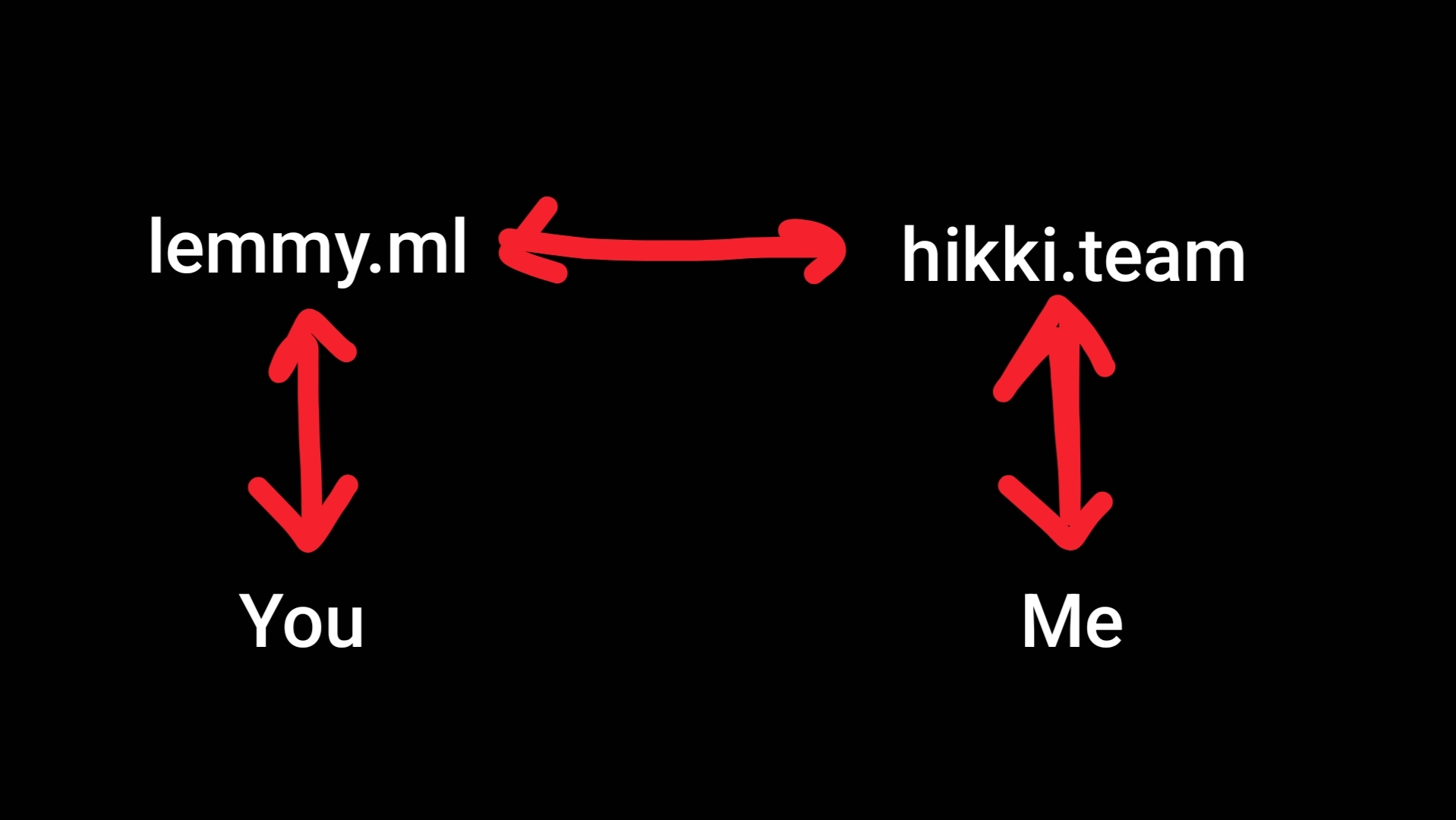
From a user perspective, the interaction within an instance or between them doesn’t differ at all, and that’s the whole point. No matter where you enter Lemmy, you connect to all of it. You see my reply regardless.
It’s not just Lemmy, either. People coming to PieFed/Kbin/Mbin can also see this post, the comments, and reply to them. The software they use affects their user experience, but doesn’t change their ability to connect with others. That’s one of the key promises of Fediverse - ideally, all Fediverse instances (websites) running any Fediverse software should interact in this way, forming a single network that everyone interacts with in their own way.
Thanks for taking the time for making that explanation. Maybe i was unclear in my question, i was asking how the specific fedizen project was working from a users point of view: e.g. it has curated collections of communitities: do I, as a user, need to go to the fedizen website to experience this? Or is it federated somehow? This was not clear from the announcement. To me at least.
Why is the development group not federated?
It’s going to be, group federation only partially works in Bonfire today. The devs are very close to shipping it in an upcoming stable release.
That’s… how lemmy works by default? I don’t get it.
Seems to be a mix between what WeDistribute currently is, but aggregating content from different sources, and a Bonfire instance. So an effort to mix the old web with the social web. The best parallel to me seems to be websites with associated forums back in the old days, but a federated version.
I’m interested to see how it works out.
The link to Fedizen.net in the article appears to be dead
Should be good now, we redeployed onto a beta release to test out some feature fixes. We’re basically dogfooding this every day!
ha, i wouldnt call that new. from the description, its just a super-auto-subscriber with large local store and prolly some nice search on that store.
but, theres like a dozen apps that do that now… and kinda have for years.
what am i missing that sets this apart?
No, that’s accurate. It’s basically that, except it’s done through ActivityPub federation, aggregates a bunch of different types of activity objects, and makes them sortable / searchable / filterable / rendered in a pretty interface. It can even help provide a lot of that info to other instances connected to it.
Like, aside from some foundational bits, the technology itself is not super special. Actually, Bonfire does a ton of really cool things under the hood, but that’s only a little bit relevant.
On the bright side, it does make a bunch of things easier to find, search for, and learn about:
- Groups
- Events
- Articles
- Collections of Actors
- Any type of media
Like, honestly it’s an idea that sounds kind of stupid on the surface, but it’s basically federated Yahoo with a grassroots bent. But I think there are aspects, from a community organizing aspect, that this could actually be useful. It’s like hyperlocalism but for the network itself. You offer ways for people to find communities, read about what’s being developed, find some mom and pop business, commission an artist, listen to some music.
I think what might really set it apart is that no one has built a Fediverse instance specifically geared towards that way of thinking. That’s what we’re interested in trying.
its funny, because i setup my server with the idea in mind i would just subscribe the “system” to everything, making the local search the primary one for users.
mbin was the only product at the time that covered the most AP objects so i could grab microblog and threadiverse shit.
scaling will always be an issue. not sure how youre going to get around that… and the god damn scrapers. its hard to keep an open system when the world wants to break it.
“What’s he building in there?”
I applaud the Tom Waits reference at the top of the article.
Sounds like what I’ve been dreaming of for a while. Curious to see how things work out.